Build the skills that hold the line.
Real targets, ranges nobody else is on, and a path that tells you what to learn next.
One path, not a pile of challenges.
Every concept builds on another.
Nothing here stands on its own. Finishing a module unlocks the ones that were waiting on it, so the route from a first HTTP request to a full range compromise is something you can see rather than guess at.
0%path lit
Curriculum designed for real work.
Modules stack from foundations to full-chain red team ops. Open one to see what you leave able to do.
Networking, Linux and the HTTP request lifecycle. You leave this track able to read a packet capture and script a client from nothing.
No prerequisitesInjection, deserialisation, SSRF and auth bypasses against applications that fight back. Every module ships its own container.
Live targetsBreak and harden real services on isolated targets. Every module ships a container you spawn yourself, a flag you have to earn, and a writeup you file afterwards.
Live targetsMulti-host topologies over VPN. Pivot from a DMZ web host into an internal segment your own machine cannot route to.
VPN requiredFull-chain engagements against a running range: initial access, persistence, lateral movement, then a report a client would actually accept.
Advanced tierDraw the network. Arena builds it.
Trainers and admins compose their own labs on a canvas. Drop in virtual machines, routers, switches and isolated networks, wire the ports, then deploy the whole topology to Proxmox in one click.
Drag, drop, wire
Place machines, routers and networks on the canvas and connect them port to port. What you draw is what gets provisioned.
Real appliances
Boot vendor router and firewall images, then push startup config over the serial console, with no guest agent required.
Isolated by default
Each network becomes its own SDN segment with static addressing, so two teams can run the same lab without ever seeing each other.
Version it like code
Every topology exports to the Arena DSL or YAML, so a lab can be reviewed, diffed and re-imported on another deployment.
A full attack box, waiting in the cloud.
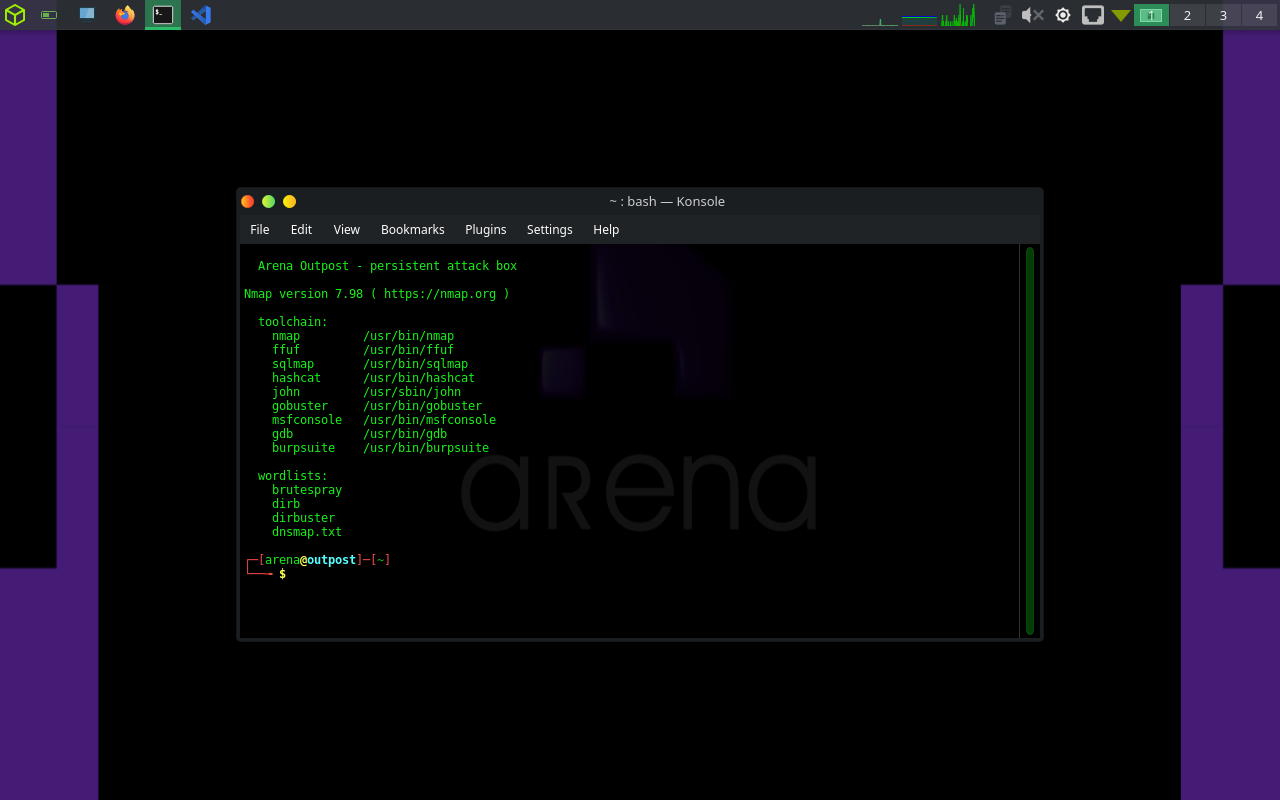
Every operator gets an Outpost: a persistent, isolated desktop that boots on demand, sits beside the lesson you are reading and routes straight into any range you own. Nothing to install locally.
Your files survive
Home directory, keys, wordlists and notes persist across every stop and start.
Toolchain already there
Recon, exploitation, reversing and forensics tooling, versioned and kept current for you.
One tunnel, every range
Your Outpost is wired to the VPN, so any lab you spawn is reachable the moment it turns green.
Side by side with the lesson
Read the module on the left, work the target on the right. Record the session, or hand a replay to a trainer.
Showdown
Invite an operator. Both of you spawn the same challenge at the same second, and the first valid submission ends it. No flag to paste: a submitter binary inside your own instance calls the win home, so the only thing that decides the match is who breaks it first.
The accepter picks the ground
Whoever takes the invite chooses category and round length. Arena serves a challenge neither of you has opened before.
Nobody wins, nobody leaves
If the clock runs out clean, sudden death drops in on an easier variant at half the timer and 0.7x the rating swing.
Rating that actually moves
Standard ELO at K=32. Beating someone above you pays out hard. A draw costs both sides five points.
Pay for what you actually need.
Start on the free tier and move up when you need isolation, network ranges or a machine of your own. Change or cancel your plan whenever you like.
- Shared Network Labs that you join in seconds
- Network ranges, every one of them, on a shared instance
- Full challenge catalogue, including retired challenges
- 5 concurrent deployments
- Access to Outpost, the in-browser dedicated Kali Linux (limited to 5 hours a day)
- Access to Pro-level courses (and their challenges)
- Everything in Pro, plus:
- Isolated labs, a private instance nobody else is on
- The same network ranges, but your own private topology
- Unlimited concurrent deployments, and longer TTLs
- Unlimited Outpost usage, with session recording if you want to review what you did
- Access to AirOverflow's Advanced courses with their practical labs
- Everything in Advanced, for every seat
- Single sign-on with OIDC, SAML, LDAP and SCIM provisioning
- Your own tenant, private content and org leaderboards
- Topology builder and custom challenge authoring
- Trainer portal for cohorts, assignments and reporting
- Self-hosted or air-gapped deployment
Questions, answered
What Arena is, what is on it, and what it costs.
What is AirOverflow Arena?
AirOverflow Arena is a hands-on cybersecurity training platform. It combines structured courses with isolated lab environments you launch in the browser, CTF-style wargame challenges, live competitive events, and 1v1 Showdown duels.
Do I need to install anything to use Arena?
No. Labs and challenges run on Arena's infrastructure and are reached from the browser or over a VPN profile Arena issues you, so nothing has to be installed or configured on your own machine.
Which topics does Arena cover?
Binary exploitation, web security, reverse engineering, digital forensics, cryptography, Wi-Fi and wireless attacks, Active Directory and network labs, and Windows exploitation.
Is Arena suitable for beginners?
Yes. Courses start at beginner level with guided walkthroughs and build up to hard and insane challenges, so the same platform works for a first lab and for competitive CTF practice.
Is there a free tier?
Yes. Arena has a free tier with access to a set of challenges and labs, and paid tiers that raise the limits and unlock the full course catalogue.
How much does AirOverflow Arena cost?
The free tier costs nothing. Pro is $15 per month and adds shared network labs, the full challenge catalogue, five concurrent deployments and five hours of Outpost a day. Advanced is $25 per month and adds isolated labs, private topologies, unlimited concurrent deployments and unlimited Outpost. Enterprise is quoted per organisation and invoiced annually.
What is Outpost?
Outpost is a full Kali Linux desktop that runs in Arena's infrastructure and is used from the browser, so an attack machine is one click away and nothing has to be installed locally. Pro includes five hours a day; Advanced is unlimited.
What is a Showdown duel?
A Showdown is a 1v1 duel: two players get the same challenge at the same moment and the first to submit the flag wins. Results are rated with an ELO score, and a tie goes to sudden death on a second challenge.
Can Arena be used by a company or a university?
Yes. Organisations get their own tenant with an administration portal, their own private courses and events, single sign-on (OIDC, SAML or LDAP), SCIM user provisioning and per-organisation reporting.
Does Arena run capture-the-flag competitions?
Yes. Arena hosts jeopardy, king-of-the-hill and attack-and-defense events, online or on-site, for individuals, teams or whole organisations, and it has run national competitions including the Pakistan Cyber Challenge.
More detail: the course catalogue, every challenge and past competitions.